
Checking Criminal History in Tuscola
Begin with the event, not a broad name search. A Tuscola police report, Douglas County jail entry, Circuit Court case, and Illinois conviction response answer different questions. The police record describes the reported event and officer action. Booking data shows custody at a point in time. A court file shows the charge the prosecutor filed and what the judge later did. State history may join fingerprint-supported arrest cycles to reportable outcomes, but the public UCIA product is limited to conviction information.
Use this five-part route when the exact record holder is not yet clear:
- Ask Tuscola Police or the City Hall FOIA officers for a city incident or arrest report, using a report number, event date, and record type when known.
- Request inspection or copies in writing, and ask for the segregable public portions if protected facts must be removed.
- Check the Douglas County Sheriff app for current custody, then use VINELink or call corrections if the person is not shown.
- Search the Douglas Judici endpoint or contact the Circuit Clerk for filed criminal, traffic, and ordinance cases.
- Use ISP CHIRP for public statewide conviction information or fingerprint Access and Review for your own fuller Illinois transcript.
This order limits false matches. It also explains why a Tuscola event might appear in one system before another.
Two Tuscola Police Record Addresses
Tuscola has two local addresses that serve different purposes. The city identifies the police station at 204 North Parke. The City Hall FOIA process runs through 214 North Main, where officers J. Drew Hoel and Alta L. Long receive city requests. Calling Police Chief Craig Hastings at 217-253-2351 can clarify whether a requested report exists, but a written request to the proper FOIA route creates a clear description and delivery trail.
The distinction matters in a city that also houses county offices. Neither local address is the Douglas County Sheriff at 920 South Washington, and neither is the Circuit Clerk in Room 204 of the courthouse. A request addressed only to “Tuscola records” may therefore reach the wrong custodian.
The official Tuscola FOIA display shows the local procedure and City Hall information.
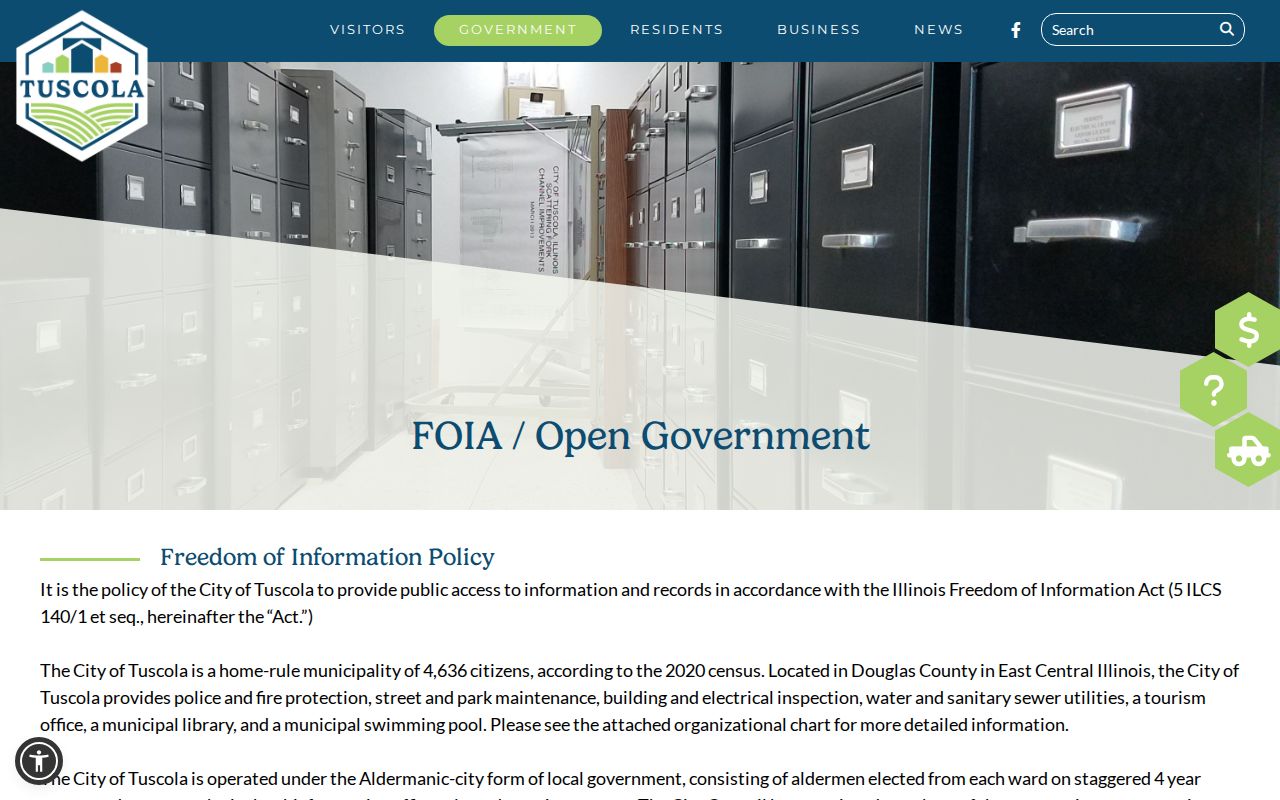
It confirms why the request counter and police station must not be treated as the same address.
Tuscola City Hall FOIA
214 N Main
Tuscola, IL 61953
Fax: 217-253-5026
Weekdays, 7:30 a.m.–4:30 p.m.
Tuscola Police
204 N Parke
Tuscola, IL 61953
217-253-2351
Ask which channel holds the requested police record.
Tuscola Police Department Records
Tuscola Police creates reports for incidents investigated by city officers. Those files may include event details, involved parties, evidence, officer actions, and an arrest narrative. Release depends on the contents and status. Open-investigation facts, victim identifiers, juvenile material, medical information, tactics, and security details may be withheld or redacted. The proper response is not to assume the whole file is secret. Ask for the nonexempt portions that can be separated.
The city’s records rules allow a verbal request, but the city may require writing. A useful request identifies the type of document, date range, police department, report number if known, and desired format. Electronic delivery can avoid needless copy charges. The city may also ask enough detail to conduct a reasonable search.
The city marked Chief Hastings’s 45th anniversary in 2025. That is evidence of leadership continuity, not proof of any unwritten release practice. Current written policy and the named custodian still control each Tuscola request.
The city’s officials page supplies the current police leadership contact.

That contact supports routing, while written FOIA policy still controls disclosure.
Tuscola Criminal Record Copy Costs
Tuscola publishes a clear local copy rule. Inspection may take place during City Hall’s weekday hours. The first 50 black-and-white letter or legal pages are free. More pages cost 15 cents each, while nonstandard media may be charged at actual reproduction cost. A requester can narrow a large file, ask for electronic records, or inspect before choosing pages.
| Request option | Tuscola rule | Practical use |
|---|---|---|
| Inspect | City Hall, 7:30 a.m.–4:30 p.m. weekdays | Review a large file before ordering copies |
| First 50 pages | Free for black-and-white letter/legal copies | Often enough for a focused report request |
| Additional pages | $0.15 per page | Ask for an estimate on lengthy files |
| Other media | Actual reproduction cost | Confirm format and price in advance |
Noncommercial requests ordinarily receive a response within five business days. A lawful written extension may add no more than five business days for listed reasons. That deadline governs the response, not a promise that every requested page will be released.
Tuscola Arrests and Bookings
Tuscola has no advertised city jail. When city police take a person into custody, detention routes to the Douglas County Jail. The city police report stays with Tuscola, while jail intake creates a separate sheriff record. For the most current population, the county directs users to the Douglas County Sheriff’s Office app. Android users can use its official Google Play listing. Corrections at 217-253-2913 is the direct fallback, and Illinois VINELink can help with custody status and notification.
Absence from the live list does not state why a person left. Release, transfer, a periodic sentence, or another status change may be involved. Match the booking date, arresting agency, charge, and case number before linking custody data to a court file. The detailed county process belongs in the Douglas County arrest lookup.
Note: A booking entry records custody and alleged charges at that time; it is not a conviction or a final case outcome.
Tuscola Has No Separate Docket
Tuscola publishes no independent municipal court search. Illinois uses a unified Circuit Court system, so city ordinance, traffic, misdemeanor, and felony matters that become court cases route to Douglas County Circuit Court. This can surprise a searcher who expects a city court portal. The city keeps ordinance and policy records, but adjudication appears in the county court file.
Use the judiciary-linked Douglas Judici endpoint first. CAPTCHA can block automated review, so no unverified search fields or refresh schedule should be assumed. If the portal does not answer the question, contact the Circuit Clerk at 217-253-2352, email circuit.clerk@douglascountyil.gov, or visit Room 204 at 401 South Center during 8:30 a.m.–4:30 p.m.
Tuscola Municipal Court Records
The phrase “municipal court record” in Tuscola usually means a city ordinance or traffic matter filed in Douglas County Circuit Court. The clerk, not City Hall, holds the judicial docket, orders, disposition, sentence, and financial entries. City Hall may still hold the ordinance text, enforcement policy, or related police report.
| Court Name | Douglas County Circuit Court, Sixth Judicial Circuit |
|---|---|
| Case Types Heard | Tuscola ordinance, traffic, misdemeanor, felony, and other trial-level matters |
| Case Lookup Channel | Douglas Judici endpoint, Circuit Clerk phone/email, or Room 204 counter |
| What the Docket Shows | Case number, filed charge, events, hearings, orders, plea, disposition, sentence, and financial entries when public |
| Copies & Fees | Ask the clerk for current plain or certified-copy pricing; no verified current Douglas criminal-copy fee was found |
A certified police record and a certified court record are not interchangeable. Ask which office created the proof that is actually needed.
Tuscola Home-Rule Record Boundaries
Tuscola’s home-rule and aldermanic structure helps explain the split. The city maintains local ordinances, council policy, permits, and municipal administration. Its $25 golf-cart permit is one example of a local rule administered by city government. That fact does not establish a criminal case. It shows why ordinance and permit records may stay at City Hall even when a contested or charged matter proceeds through Circuit Court.
The city and county also use Hyper-Reach for emergency notices, with capacity reported at 50,000 calls per hour. Alert administration is a public-safety function, but it is not an arrest log. A requester should name the alert, policy, message, or report sought instead of asking broadly for “criminal records.”
Historic research follows a different path. Tuscola’s digitized sesquicentennial history can support genealogy and civic research, while current police, custody, and court records remain with their present custodians.
Tuscola Public-Safety Alert Records
Hyper-Reach messages occupy a useful middle ground between police records and city administration. The city and county use the service for emergency notices, and its reported capacity is 50,000 calls per hour. An alert may show what officials told the public at a specific time, but it is not a police report, booking entry, or court finding.
Identify the alert date, topic, sending department, and whether the message, policy, or delivery log is sought. City Hall can route city-created alert records. Ask police for an incident report only when police created one.
Where Tuscola Records Go
A city incident can produce several records without turning them into one master file. Tuscola Police writes the incident or arrest report. If detention occurs, the Douglas County Sheriff creates booking and custody records. The State’s Attorney decides what to file, and the Circuit Clerk opens the court case. Qualifying arrest identifiers and dispositions may later reach the Illinois State Police Bureau of Identification.
Record flow: Tuscola Police Department › Douglas County Courts › Illinois State Police Bureau of Identification
Recent activity is often easiest to confirm at the first agency that created it. Older outcomes belong in the court file. Public CHIRP results supply Illinois conviction information, not every report, booking, pending charge, or dismissal. For your own more complete state transcript, use ISP fingerprint-based Access and Review and its Record Challenge process.
When Tuscola Records Disagree
Dates are the first check. Incident, arrest, booking, filing, disposition, and release dates describe separate events. Then compare the agency, report or case number, statute, and charge text. A common name alone is not enough. If a jail entry appears but no case does, the filing may lag or prosecutors may not have filed that charge. Call the clerk rather than treating the gap as a final outcome.
If the person no longer appears in current custody, use VINELink and the court file. Neither source should be stretched beyond its purpose. For a wrong police report, start with Tuscola’s custodian. For an incorrect court disposition, obtain the Douglas file. For an error in your own statewide history, use ISP Access and Review and Record Challenge.
Public Access Rules in Tuscola
Illinois FOIA gives the public a way to request city police and administrative records. It does not make each line public. A clear request should identify the record and ask for segregable portions when privacy, an active investigation, juvenile information, victim details, tactics, medical data, or security information requires redaction. Written denials may be reviewed by the Illinois Attorney General’s Public Access Counselor or challenged in Circuit Court.
Key Statutes:
Illinois FOIA, 5 ILCS 140/3 sets the ordinary five-business-day noncommercial response period and permits limited written extensions.
Uniform Conviction Information Act, 20 ILCS 2635/1 et seq. makes ISP-held conviction information public without opening every nonconviction record.
730 ILCS 150/3 governs sex-offender registration data and local registration duties.
A printed portal result is not always certified proof. Ask Tuscola for certification of its own record and the Circuit Clerk for certification of a court document.